Jun 19, 2026
5 Mental Shifts Every Corporate Worker Needs Before Going Solo
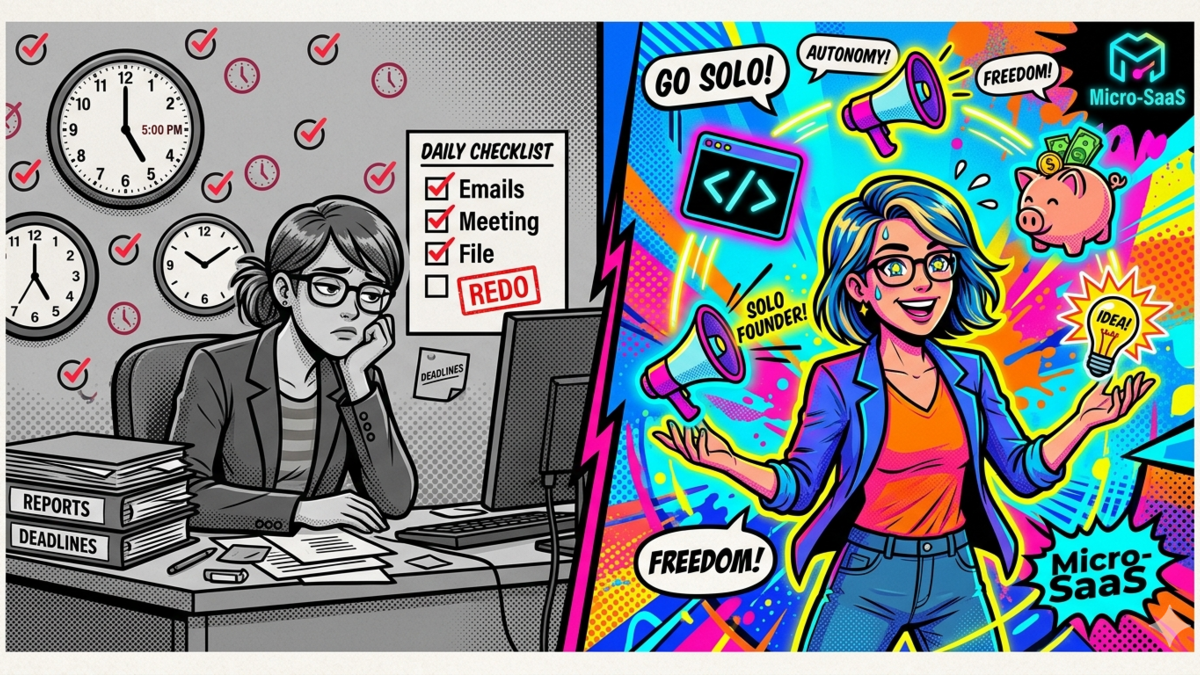
The dream of the solopreneur lifestyle is highly intoxicating: absolute autonomy, no pointless middle-management meetings, and the ability to capture 100% of the value you create. It sounds like the ultimate career upgrade.
But here is the cold truth that data from hundreds of deep founder interviews reveals: most solo ventures don't fail because the product idea was bad. They fail because the founder tried to run a one-person empire using an employee’s mental operating system.
When you transition from a corporate cog to a solo founder, you aren't just changing your daily tasks—you are rewriting your entire psychological framework.
If you are ready to stop dreaming and start building, these are the 5 critical mindset shifts you must make to survive and thrive in the modern leverage era.
1. Shatter Your Comfort Zone: Welcome to Radical Multitasking
In a traditional 9-to-5 job, hyper-specialization is rewarded. If you are a software engineer, you write code. If you are a copywriter, you craft headlines. The accounting team handles the books, and the growth team runs the ads.
The moment you go solo, your job description becomes simple: Everything.
- Employee Mindset: Hyper-Specialized ("That's not my department.")
- Solopreneur Mindset: Radical Generalist ("I am the department.")
You will have to market, sell, handle customer support, do bookkeeping, and build the actual product. For many, doing things outside their core competency feels deeply uncomfortable. However, unlocking your solopreneurs' flow requires you to lean directly into that discomfort. You don't need to be a world-class expert in every field, but you must be willing to learn the basics of the entire business stack to survive.
2. Shift from Time-Oriented to Result-Oriented Thinking
Corporate life trains us to equate hours spent with value delivered. You sit at a desk for 8 hours, look busy, and get a predictable paycheck at the end of the month.
The market, however, does not care about your effort. It only cares about value.
As a solo founder, working 14 hours a day on a feature nobody wants yields exactly $0. Conversely, spending 30 minutes writing a highly-targeted landing page that solves a specific pain point could generate thousands in recurring revenue.
Stop measuring your success by how "exhausted" you are at the end of the day. Your new business KPI isn't time spent; it’s results achieved. This requires a level of self-awareness that acts as your ultimate market moat.
3. Disconnect Hard Work from Certain Rewards
We’ve been conditioned since childhood to believe in linear rewards: Study for X hours, get an A. Work hard for a year, get a 5% raise.
In solopreneurship, the relationship between input and output is completely non-linear.
- The Delay: You might grind for three months on a Micro-SaaS tool and see absolutely zero traction, only for an article you wrote weeks ago to suddenly go viral and bring in 500 users overnight.
- The Dead End: You might pour your heart into an idea, only to realize you built it in the wrong direction.
- The Windfall: A minor tweak to your offer might suddenly yield rewards far greater than you ever anticipated.
To survive this emotional rollercoaster, you need to cultivate severe psychological resilience. Understanding your specific personality mechanics—like how different Enneagram types react to pressure—is vital to keeping your footing when the rewards don't match your immediate output. You can dive deeper into this in our guide on why psychology is the secret weapon for your solopreneur success.
4. Radical Ownership: Admit Mistakes, Fast-Track Improvements
In a corporate environment, making a mistake often triggers a defensive survival mechanism: Hide the error, find an excuse, or pass the blame to another department.
When you are a one-person brand, there is no one to pass the buck to. The buck stops, starts, and lives with you.
The Solo Rule: A mistake is not a permanent mark on your record; it is simply free data from the market.
If your product launches to crickets, or a software bug wipes out a user's dashboard, you cannot afford to waste energy covering it up. Own it completely, apologize transparently, fix it, and carry on. The faster you admit a mistake, the faster you can pivot. This rapid-fire feedback loop is precisely why starting small is the ultimate power move over slow, bureaucratic corporate giants.
5. Normalize Chaos: Unstable and Unexpected is the Default Mode
If your mental health relies entirely on static daily routines, strict corporate protocols, and predictable weekly schedules, the transition to going solo will feel jarring.
In the solo founder universe, volatility is not an anomaly; it is the default setting.
An unexpected API change might break your software on a Saturday morning. Simultaneously, a random shoutout from an influencer might send an unprecedented wave of traffic to your checkout page on a Tuesday afternoon.
Instead of fighting the chaos or letting it cause burnout, you must learn to embrace it. When you internalize uncertainty as an adventure rather than a threat, you unlock the true agility that allows solo operators to outmaneuver massive corporations.